
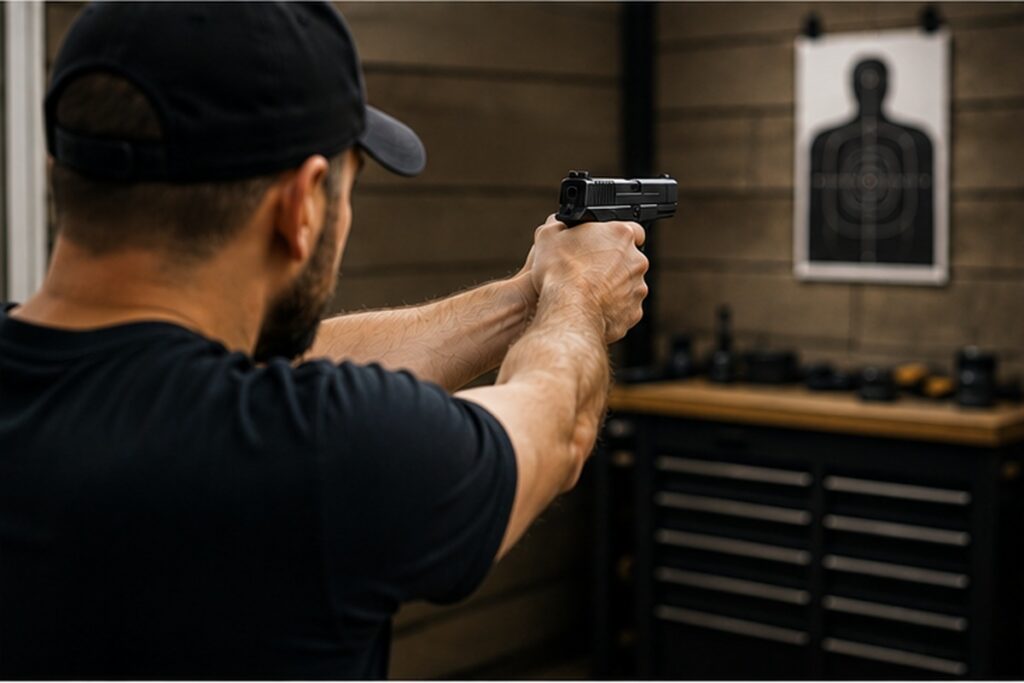
Dry Fire for Better Shooting
Improving as a shooter does not depend entirely on how much ammunition you fire.
Dry-fire practice allows responsible firearm owners to work on fundamental skills without live ammunition. When conducted safely and with a clear purpose, it can help make range sessions more productive.
However, dry fire is still firearm handling. It requires the same attention to safety as live-fire training.
What Is Dry-Fire Practice?
Dry fire involves practicing with an unloaded firearm in a controlled environment without firing live ammunition.
Depending on the shooter’s training and experience, practice may focus on fundamentals such as:
- Establishing a consistent grip
- Aligning the sights
- Pressing the trigger without disturbing the firearm
- Presenting the firearm safely
- Operating basic controls
More complex skills should be introduced through qualified instruction rather than attempted without guidance.
Before dry firing, consult the firearm’s owner’s manual. Some firearms may require snap caps or other precautions.
Safety Comes First
A dry-fire session should begin with a deliberate safety process.
Live ammunition should be removed from the practice area, the firearm should be confirmed unloaded, and a safe direction and appropriate backstop should be established.
The practice area should also be free from unnecessary distractions.
When the session ends, clearly separate training from normal firearm handling. Do not casually continue practicing after ammunition has been returned to the area.
Dry-fire safety depends on consistency—not assumptions.
Practice With a Purpose
Repeating a movement does not automatically improve it. Repeating poor technique can reinforce mistakes.
A productive session should have one clearly defined objective. This could include improving trigger control, maintaining sight alignment, or establishing a more consistent grip.
Short, focused sessions are usually more valuable than long periods of unfocused repetition.
Quality matters more than speed or volume.
Dry Fire Supports Range Training
Live fire introduces recoil, noise, timing, and firearm movement that cannot be fully recreated at home.
Dry fire can help a shooter prepare the mechanical parts of a skill. Live fire then shows whether those movements remain effective under actual shooting conditions.
Together, the two forms of practice can create a useful training cycle:
- Learn and refine a skill
- Test it during live fire
- Identify areas needing improvement
- Return to focused practice
This approach gives each range session a purpose instead of simply measuring progress by the number of rounds fired.
Technology Can Provide Feedback
Snap caps, laser devices, and other training tools may help support practice, but they are not substitutes for proper technique or professional feedback.
A device can show movement or provide a visual reference. It may not identify why the movement occurred or how to correct it.
Tools are most valuable when used within a structured training plan.
Build Good Habits Early
Dry fire can help improve consistency, but only when safety and correct technique are maintained.
New shooters should receive instruction before adding advanced manipulations, holster work, speed, or movement to home practice. Building a strong foundation first reduces the likelihood of reinforcing unsafe or ineffective habits.
PRIDAN training helps shooters understand how to practice safely, identify the fundamentals that need attention, and connect dry-fire preparation to purposeful range sessions.
Practice with purpose. Confirm it at the range.